

Black Box vs White Box Modeling in SysML

Black Box vs White Box Modeling in SysML
When building system models in SysML (Systems Modeling Language), engineers often analyze systems from two different perspectives: black box modeling and white box modeling.
These two viewpoints help engineers understand both the external behavior of a system and the internal structure that enables that behavior.
Understanding when to use each perspective is a core concept in Model-Based Systems Engineering (MBSE).
What Is a Black Box View in SysML?
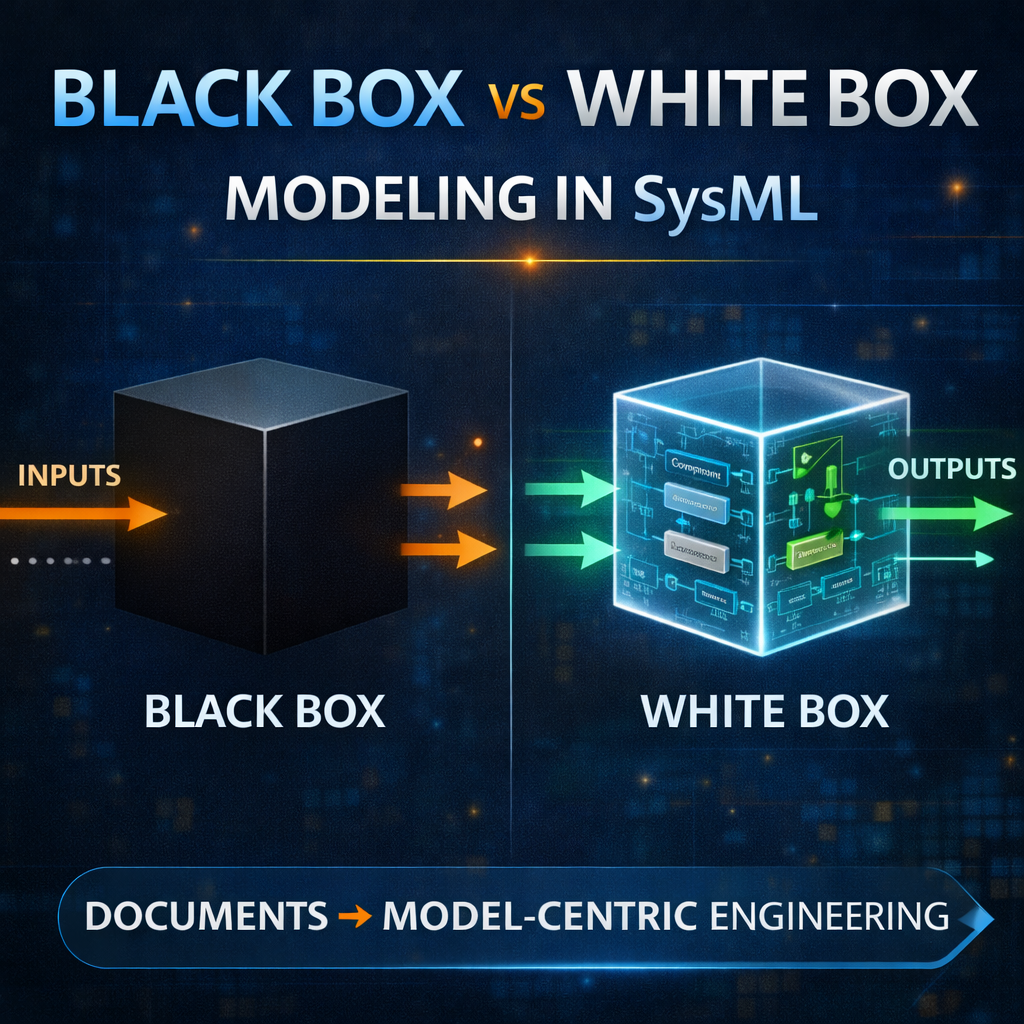
A black box view represents a system from the outside without exposing the internal implementation.
In this perspective, the system is treated as an opaque object where only the inputs, outputs, and observable behaviors are visible.
Black box modeling focuses on:
-
system inputs and outputs
-
external interfaces
-
system-level behavior
-
interactions with users or other systems
This view is commonly used when:
-
defining system requirements
-
communicating functionality to stakeholders
-
analyzing system interactions
-
describing system behavior at a high level
For example, when modeling a drone delivery system, a black box view might simply show:
-
delivery request input
-
drone delivery process
-
package delivered output
The internal mechanics of the drone — navigation systems, propulsion, and control software — are intentionally hidden.
Because of this abstraction, black box models are very effective for stakeholder communication and early system architecture discussions.
What Is a White Box View in SysML?
A white box view exposes the internal structure and behavior of a system.
Instead of treating the system as opaque, the modeler looks inside the system to understand how components interact to achieve system functionality.
White box modeling focuses on:
-
internal components or subsystems
-
relationships between components
-
internal data flows
-
detailed behaviors and interactions
Common diagrams used for white box modeling include:
-
Internal Block Diagrams (IBD)
-
Activity Diagrams describing internal processes
-
Sequence Diagrams showing component interactions
Continuing the drone example, a white box view might show:
-
flight controller
-
navigation subsystem
-
battery system
-
payload release mechanism
-
communication links between subsystems
This level of detail helps engineers:
-
refine system architecture
-
analyze system behavior
-
identify integration issues
-
optimize subsystem interactions
Transparent vs Opaque System Views
Another way to understand the difference is by thinking about transparency.
A white box system is like a transparent box.
Engineers can see the internal components and understand how everything works together.
A black box system is like an opaque box.
Engineers can observe what goes into the system and what comes out, but the internal details remain hidden.
Both perspectives are necessary when developing complex systems.
Why Both Views Are Important in MBSE
Model-Based Systems Engineering relies on using multiple viewpoints of the same system model.
Black box and white box perspectives allow engineers to move between high-level system behavior and detailed system architecture.
Black box models help with:
-
stakeholder communication
-
requirements definition
-
system-level analysis
White box models help with:
-
architectural design
-
subsystem decomposition
-
system integration and verification
Together, these views provide a complete understanding of the system from both functional and structural perspectives.
Final Thoughts
Black box and white box modeling are complementary approaches within SysML and MBSE.
A black box view focuses on what the system does, while a white box view focuses on how the system works internally.
Effective system models typically evolve from black box views early in the design process toward more detailed white box representations as the architecture matures.
By combining both perspectives, system engineers can build models that support requirements analysis, architecture development, and system verification throughout the lifecycle.