

What Is a Digital Twin? Understanding the Difference Between Digital Twins and Systems Models

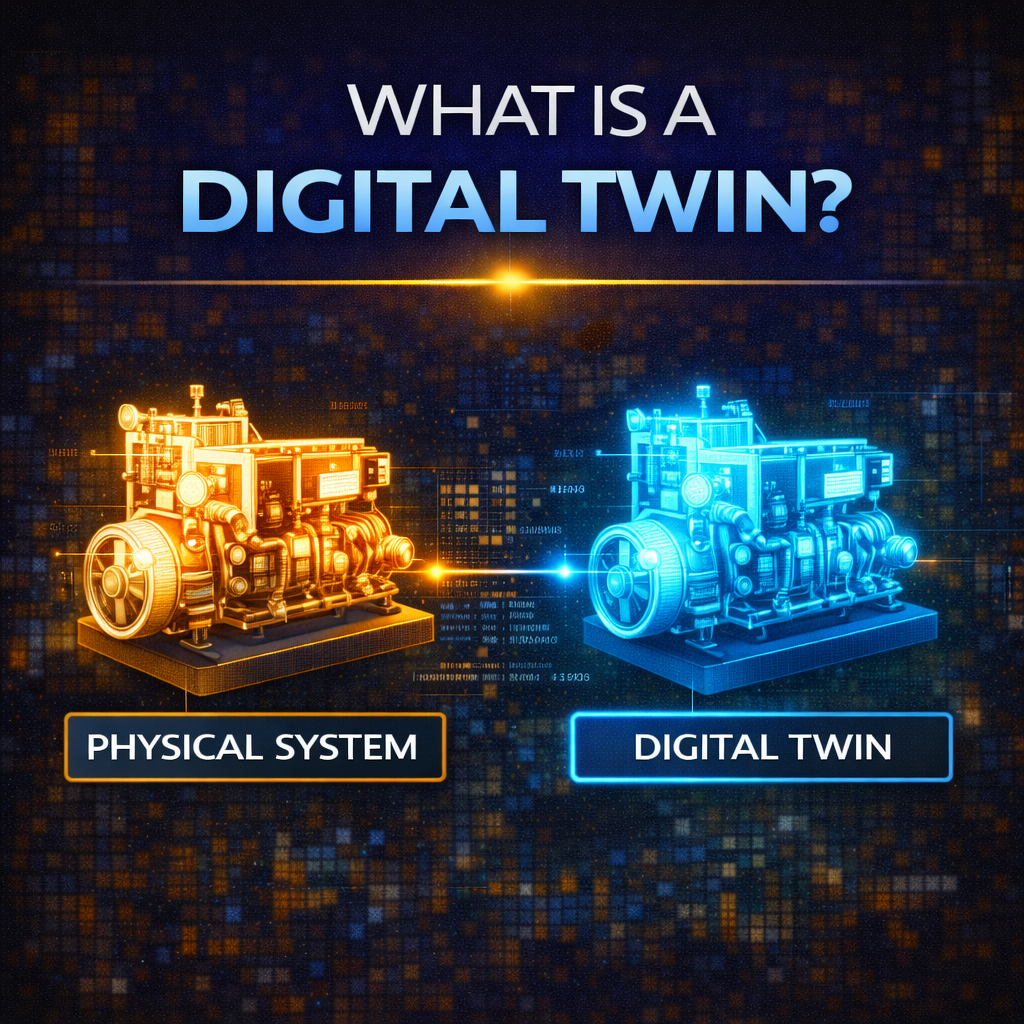
What Is a Digital Twin?
A digital twin is a high-fidelity digital representation of a specific physical system that can be used to analyze, simulate, and predict system behavior.
According to the Systems Engineering Body of Knowledge (SEBoK), Ron Giachetti defines a digital twin as:
“A high-fidelity model of the system which can be used to emulate the actual system. An organization would be able to use a digital twin to analyze design changes prior to incorporating them into the actual system.”
In practice, a digital twin allows engineers to experiment with a virtual version of a real system before making changes in the physical world. This helps reduce risk, cost, and development time.
Digital twins are increasingly used in industries such as:
-
aerospace
-
manufacturing
-
automotive
-
energy systems
-
infrastructure
These digital representations enable organizations to monitor performance, predict failures, and optimize system operations.
What Makes a Digital Twin Different?
A digital twin is intended to represent a specific instance of a system, not just a general design model.
Two key characteristics define a digital twin:
High Fidelity
A digital twin typically contains detailed models of system behavior, structure, and performance. These models may incorporate real-time data, physics-based simulations, or operational data from sensors.
Instance-Specific Representation
Each physical system instance (for example, each aircraft, vehicle, or factory machine) ideally has its own digital twin.
For example:
-
Aircraft tail number A123 would have its own digital twin
-
Aircraft tail number A124 would have a separate digital twin
Even though the aircraft designs are similar, each system may experience different operational environments, maintenance histories, or usage patterns.
How Digital Twins Are Used
Digital twins are particularly valuable for long-lived or continuously operating systems.
For example, in a manufacturing plant, a digital twin could be used to:
-
monitor system performance
-
predict equipment failures
-
optimize maintenance schedules
-
simulate production changes
-
evaluate upgrades before implementation
Because the digital twin can incorporate operational data from sensors and monitoring systems, it allows engineers to make data-driven decisions about system improvements and maintenance.
What Is a Systems Model?
A systems model is different from a digital twin.
While a digital twin represents a specific physical system, a systems model typically represents a family or class of systems.
Systems models are commonly used in Model-Based Systems Engineering (MBSE) to describe system architecture, requirements, behavior, and interactions.
These models are usually abstract representations, meaning they simplify aspects of the real system in order to make the system easier to analyze and understand.
As statistician George E. P. Box famously stated:
“All models are wrong, but some are useful.”
The goal of a systems model is not to perfectly replicate reality. Instead, it is to create a useful digital representation that allows engineers to explore design options and understand system behavior.
Why Systems Models Are Important
Systems models allow engineers to simulate and analyze potential system behavior before a system is built or modified.
With a well-constructed model, engineers can test:
-
new configurations
-
alternative system architectures
-
operational scenarios
-
environmental conditions
If the model contains accurate assumptions and parameters, engineers can gain confidence that the simulation results provide meaningful insight into system performance.
This ability to experiment in a virtual environment can significantly accelerate engineering decisions.
Digital Twin vs Systems Model
| Feature | Systems Model | Digital Twin |
|---|---|---|
| Represents | System design or family of systems | Specific physical system |
| Fidelity | Moderate | High |
| Data Source | Engineering assumptions | Often includes operational data |
| Purpose | Design and architecture analysis | Operational optimization and monitoring |
Primary Takeaway
In many engineering projects, the goal is not to create a full digital twin.
Instead, engineers typically build a systems model that is “good enough” to answer the engineering questions being asked.
Developing extremely high-fidelity models can require significant time, cost, and data collection. For many design and analysis tasks, a simpler systems model can provide the insight needed to make informed engineering decisions.
The key is to build a model with just enough fidelity to solve the problem at hand.