

Why Subsystem-Level Models Matter in SysML

Why Subsystem-Level Models Matter in SysML
When engineers build systems in SysML, it is easy to focus only on the current system of interest. But strong Model-Based Systems Engineering (MBSE) requires thinking in both directions at the same time:
-
downward into subsystem-level models
-
upward into larger system and system-of-systems contexts
That is one of the most important modeling habits to develop.
In this article, we use a simple toaster example to explain why subsystem-level models in SysML matter, how they connect to larger upstream models, and how teams should think about interfaces, flows, and model hierarchy when building system architectures.
This post is based on the following video:
https://www.youtube.com/watch?v=KBDkHRjHqdg
Why Thinking Across Model Levels Is Important
A SysML model is rarely isolated.
Even when you are modeling a single system, that system usually:
-
contains lower-level subsystems
-
exists within a higher-level operational context
-
exchanges flows with external elements
-
eventually integrates into a larger architecture
That means a good modeler must constantly ask:
-
What exists beneath this level?
-
What exists above this level?
-
What interfaces cross these boundaries?
-
Which team owns which part of the model?
This is where subsystem-level modeling in SysML becomes essential.
Breaking a System into Subsystems in SysML
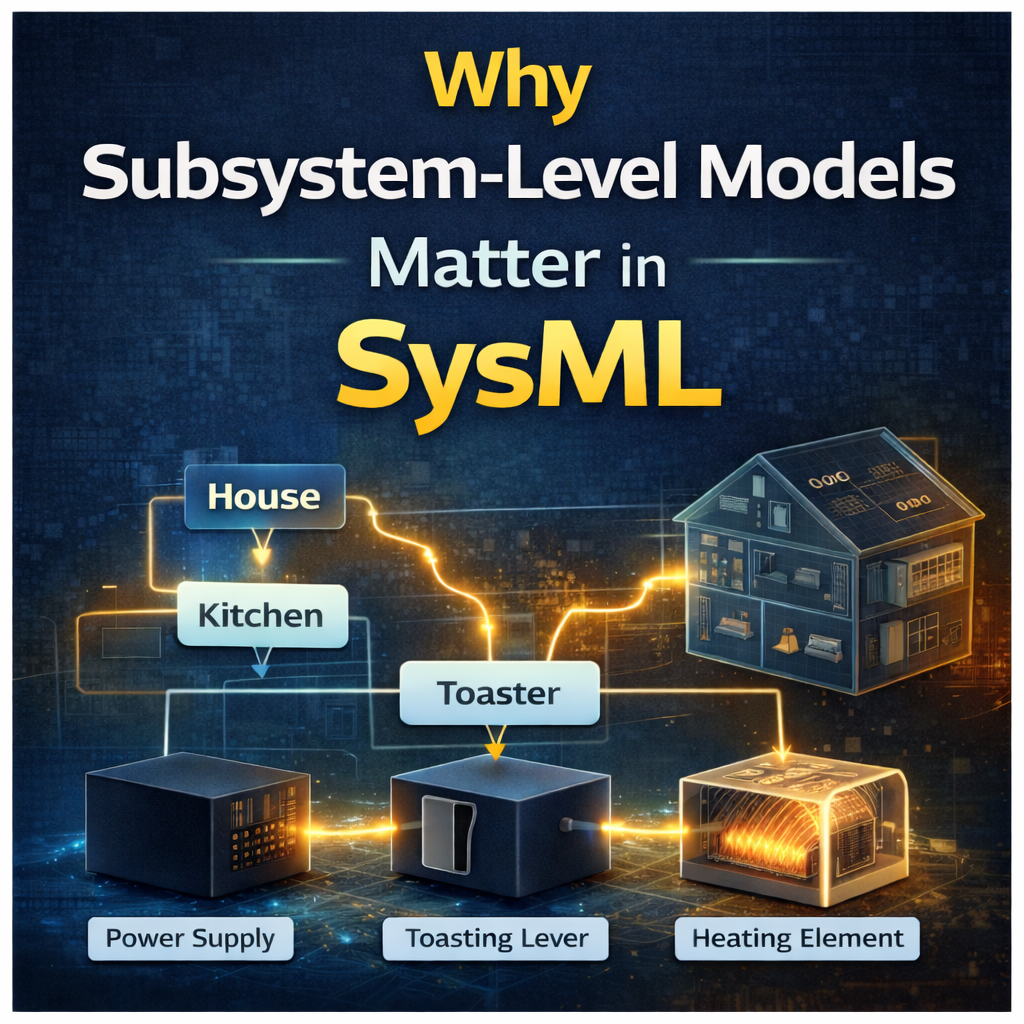
Let’s start with the example from the video: a toaster as the system of interest.
At the toaster level, you might decompose the system into subsystems such as:
-
power supply
-
toasting lever
-
heating element
This decomposition gives the engineering team a more realistic understanding of how the system works internally.
In a very simple example, these subsystems may all live inside one model. But in a more complex system, each subsystem could have:
-
its own dedicated model
-
its own engineering team
-
its own internal structure
-
its own interface definitions
That is a common reality in large MBSE programs.
Subsystem Teams Build the Lower-Level Detail
One of the key ideas in the video is that lower-level teams often create the detailed subsystem content.
For example, if the power supply were complex enough, a separate team might own that model entirely. That subsystem team would define:
-
internal parts
-
flows
-
properties
-
interface behavior
Those details would then flow upward into the higher-level toaster model.
This is an important SysML concept: higher-level models depend on subsystem-level definition, even when they do not show all the internal detail directly.
Internal Block Diagrams Show Flows Between Subsystems
Once a system is decomposed, the next step is understanding how the subsystems interact.
This is where Internal Block Diagrams (IBDs) become extremely useful.
In SysML, an IBD helps visualize:
-
the internal parts of a system
-
how those parts connect
-
what flows between them
In the toaster example, the IBD shows the interactions between internal subsystem elements such as the power supply, lever, and heating element.
At this level, the model helps engineers understand how the toaster functions internally.
Black Box and White Box Thinking in SysML
The video also highlights an important distinction between black box and white box perspectives.
White Box View
A white box view exposes the internal decomposition of the system. It shows the subsystem part properties and the internal flows between them.
For the toaster, that means seeing the internal building blocks such as:
-
power supply
-
toasting lever
-
heating element
Black Box View
A black box view treats the toaster as a single unit from the outside. Instead of focusing on internal structure, it emphasizes:
-
what comes into the toaster
-
what goes out of the toaster
-
how the toaster interacts with external elements
Both views are important, and good SysML models often need both.
Context Matters: The Toaster Does Not Exist Alone
A system should never be modeled as though it exists in a vacuum.
Once the toaster’s internal architecture is understood, the next question becomes:
What is the toaster interacting with externally?
In the example, the toaster interacts with:
-
external power
-
a slice of bread
That means the modeling team should create a context-level view showing the toaster as a black box interacting with its environment.
This is a critical step in SysML system context modeling because it clarifies:
-
what is inside the system boundary
-
what is outside the system boundary
-
which flows cross that boundary
Without that context, the model remains incomplete.
Modeling the Toaster in Its Operational Context
At the context level, the toaster becomes a participant in a larger interaction.
Now the focus shifts to flows such as:
-
power entering the toaster from an external source
-
heat being applied to the bread
This type of diagram helps define the toaster’s role in the broader system and ensures that the team understands the system’s external interfaces, not just its internal composition.
That perspective is often just as important as the internal design itself.
Integrating the System into a Larger Model
After modeling the toaster and its external interactions, the next step is to place it inside a larger system.
In this example, that larger system is the kitchen.
Now the toaster is only one element within a broader model that might also include:
-
coffee maker
-
blender
-
outlets
-
other kitchen appliances
At this level, the toaster team is no longer working alone. Their model must integrate with models owned by other teams.
This is one of the most practical lessons in MBSE: systems do not just decompose downward — they also integrate upward.
Larger Systems Require Team Coordination
In the kitchen model, each appliance may have its own model and team.
For example:
-
the toaster has its own model
-
the coffee maker has its own model
-
the blender has its own model
The kitchen team then becomes responsible for integrating those models into a coherent higher-level architecture.
This means the kitchen team may define:
-
shared interfaces
-
power distribution structure
-
external context for appliances
-
system-level interactions across devices
Those higher-level interface definitions may then flow down into the appliance teams.
This is exactly why engineers need to think about both subsystem-level and upstream-level models while modeling.
SysML Modeling Is Recursive
One of the strongest ideas in the video is the idea of recursion.
The toaster fits into the kitchen.
The kitchen fits into the house.
The house fits into a neighborhood.
The neighborhood may fit into a power grid.
At every level, the same modeling logic continues:
-
decompose the current system
-
define interfaces
-
understand context
-
integrate into the next larger level
This recursive nature is one of the defining strengths of SysML and MBSE.
It allows engineers to model complex systems across multiple tiers without losing architectural continuity.
Understanding Tier Boundaries Is Essential
As models scale, teams must clearly understand:
-
the scope of their tier
-
when one tier ends and another begins
-
which interfaces cross tier boundaries
-
which flows belong at each level
This is not just a diagramming issue. It affects:
-
ownership
-
requirements flowdown
-
integration planning
-
architecture consistency
When these tier boundaries are unclear, models become confusing and teams often duplicate work or miss critical interfaces.
Why Interfaces and Flows Between Tiers Matter
The interactions between model levels are just as important as the structure within each level.
For example:
-
the kitchen team may define power outlet interfaces
-
the toaster team must align to those interfaces
-
the toaster subsystem teams must align to the toaster’s internal interfaces
This means interfaces and flows between tiers are what hold the model hierarchy together.
In practical terms, teams should always be asking:
-
What flows cross this boundary?
-
Who owns the interface definition?
-
What should be modeled here versus at another tier?
These questions lead to cleaner, more scalable SysML models.
Converting Packages into Models in Cameo
The video also discusses a practical Cameo modeling step: converting packages into models.
This helps organize the architecture more clearly as the hierarchy grows.
By converting packages into models, you can better represent:
-
tier structure
-
project ownership
-
decomposition by system level
-
future model export boundaries
This is especially useful when preparing to separate a large architecture into multiple project files or team-owned model structures.
A Practical Model Hierarchy Example
Using the example from the video, the hierarchy might look something like this:
-
House
-
Kitchen
-
Toaster
-
Coffee Maker
-
Blender
-
-
Then within the toaster model, you may see:
-
toaster context
-
toaster-to-bread interaction
-
toaster subsystem breakdown
-
internal flows between toaster subsystems
This structure gives each level a clear purpose while still supporting upward and downward integration.
Exporting Lower-Level Content into Separate Projects
As systems grow, lower-level portions of the architecture often need to be split into their own projects.
In Cameo, one way to support this is by exporting packages to new projects.
That allows a team to start with a unified model structure, then later separate portions such as:
-
kitchen model
-
toaster model
-
subsystem model
This is useful when transitioning from a simple prototype architecture into a more realistic multi-team development environment.
Key Takeaways for SysML Model Hierarchy
When building systems in SysML, engineers should keep these principles in mind:
1. Think Downward into Subsystems
Your current system depends on lower-level subsystem detail, even if that detail is not fully shown at your level.
2. Think Upward into Context
Your system is always part of something larger and must interact with external elements and upstream architectures.
3. Use Internal Block Diagrams to Understand Flows
IBDs help clarify how subsystems interact and how the system exchanges flows internally and externally.
4. Respect Tier Boundaries
Each modeling tier should have a clear scope, ownership boundary, and interface responsibility.
5. Build for Integration
Your model should support both decomposition and upward integration into larger systems.
Final Thoughts
The toaster example may be simple, but it illustrates a powerful SysML principle:
Good system models are built by thinking across multiple levels at once.
You cannot fully understand the system of interest without considering:
-
the subsystems beneath it
-
the context around it
-
the larger systems above it
That is why subsystem-level models in SysML matter so much. They are not isolated details — they are a critical part of building coherent, scalable, and useful system architectures.
If teams understand how different model tiers interact, they can create cleaner interfaces, better decompositions, and stronger MBSE foundations.
Watch the full video here: