
Cameo Blog

Common Enterprise Architecture Frameworks (DoDAF, TOGAF, Zachman Explained)

Common Enterprise Architecture Frameworks


As systems and organizations grow in complexity, engineers and architects need structured ways to organize information across multiple levels of abstraction. Enterprise Architecture Frameworks (EAFs) provide this structure.

According to Bernard (2004), an enterprise architecture framework is:

“A structure for organizing information that defines the scope of the architecture and how the areas of the architecture relate to each other.”

In practice, EAFs help organizations describe systems, processes, data, and technologies in a consistent way across large enterprises. These frameworks define views, viewpoints, modeling standards, and organizational structures that allow teams to communicate architecture decisions effectively.

Enterprise architecture frameworks are commonly used in both defense environments and commercial industry, although the approaches can differ.


Defense-Oriented Enterprise Architecture Frameworks

Many enterprise architecture frameworks used in the defense sector were developed to support large, multi-organization systems and government programs.

While these frameworks often share similar views and viewpoints, they can differ in their underlying meta-models and data exchange standards.

Common defense-oriented enterprise architecture frameworks include:

DoDAF — Department of Defense Architecture Framework

DoDAF is the architecture framework used by the United States Department of Defense to describe and analyze military systems and capabilities.

It defines a standardized set of viewpoints for modeling:

  • operational activities

  • system architectures

  • capability development

  • program execution

One of DoDAF’s strengths is that it includes detailed data exchange standards, which help ensure interoperability between organizations and tools.


MODAF — Ministry of Defence Architecture Framework

MODAF was developed by the United Kingdom Ministry of Defence and shares many similarities with DoDAF. It provides structured viewpoints that describe operational and system architectures for defense programs.

MODAF was later merged into the Unified Architecture Framework (UAF) to support broader international collaboration.


NAF — NATO Architecture Framework

The NATO Architecture Framework supports architecture development across NATO member nations. It aligns closely with DoDAF and MODAF while supporting NATO-specific operational planning and capability development.

These defense frameworks are often aligned so that systems developed by different nations can still be interoperable and understandable across organizations.


Industry-Oriented Enterprise Architecture Frameworks

Enterprise architecture frameworks are also widely used in commercial industry. These frameworks often focus more on business architecture and IT systems rather than defense capabilities.

One challenge in industry frameworks is that there is often less standardization for data exchange compared to defense frameworks.

Common industry-oriented enterprise architecture frameworks include:


TOGAF — The Open Group Architecture Framework

TOGAF is one of the most widely used enterprise architecture frameworks in industry.

It provides:

  • a structured architecture development method (ADM)

  • a meta-model for describing architecture elements

  • guidance for designing enterprise architectures

TOGAF focuses heavily on business architecture, information systems, and IT infrastructure.


FEAF — Federal Enterprise Architecture Framework

FEAF was developed by the United States federal government to support architecture development across federal agencies.

It helps ensure that government organizations maintain consistent architecture practices and shared services across departments.


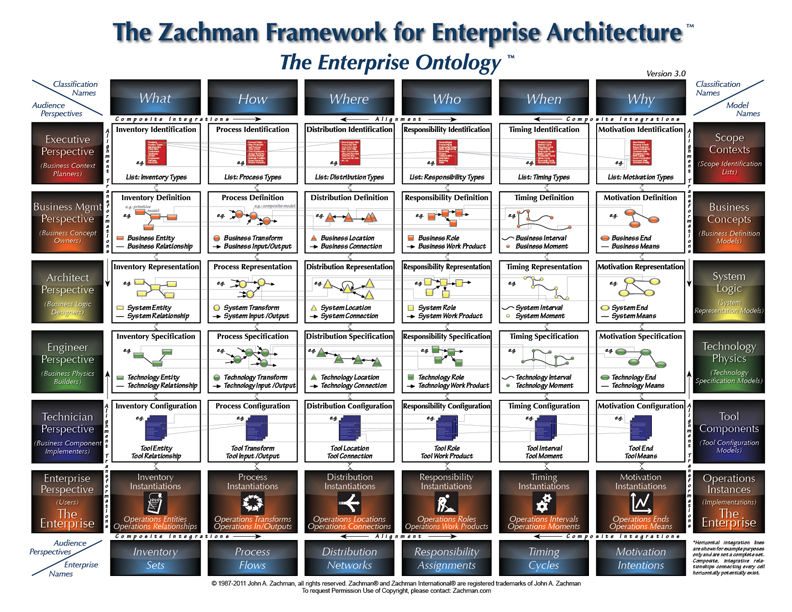
Zachman Framework

The Zachman Framework is one of the earliest enterprise architecture frameworks. It provides a structured taxonomy for organizing architectural descriptions of an enterprise.

Rather than prescribing a specific methodology, Zachman provides a classification schema that organizes architecture artifacts across multiple perspectives.

These perspectives include:

  • planners

  • owners

  • designers

  • builders

  • subcontractors

This structure helps ensure that enterprise architecture artifacts are organized and understandable across different stakeholder roles.


Defense vs Industry Frameworks

One key difference between defense and industry frameworks is the level of standardization around data exchange.

Defense frameworks such as DoDAF often include detailed guidance for data interoperability and architecture data sharing, which is critical when multiple organizations collaborate on large defense programs.

Industry frameworks tend to focus more on architecture governance and methodology, leaving tool integration and data exchange standards more flexible.


Final Thoughts

Enterprise Architecture Frameworks help organizations manage complex systems by providing structured ways to organize architecture information and viewpoints.

Whether used in defense programs or commercial enterprises, these frameworks help teams:

  • communicate architecture decisions

  • manage complexity across organizations

  • maintain consistency in system descriptions

  • support long-term system evolution

Understanding the most common frameworks — including DoDAF, TOGAF, and the Zachman Framework — provides a strong foundation for anyone working in enterprise architecture or Model-Based Systems Engineering (MBSE).

Leave a Reply

Your email address will not be published. Required fields are marked *