

MBSE vs Traditional Systems Engineering: What’s the Difference?

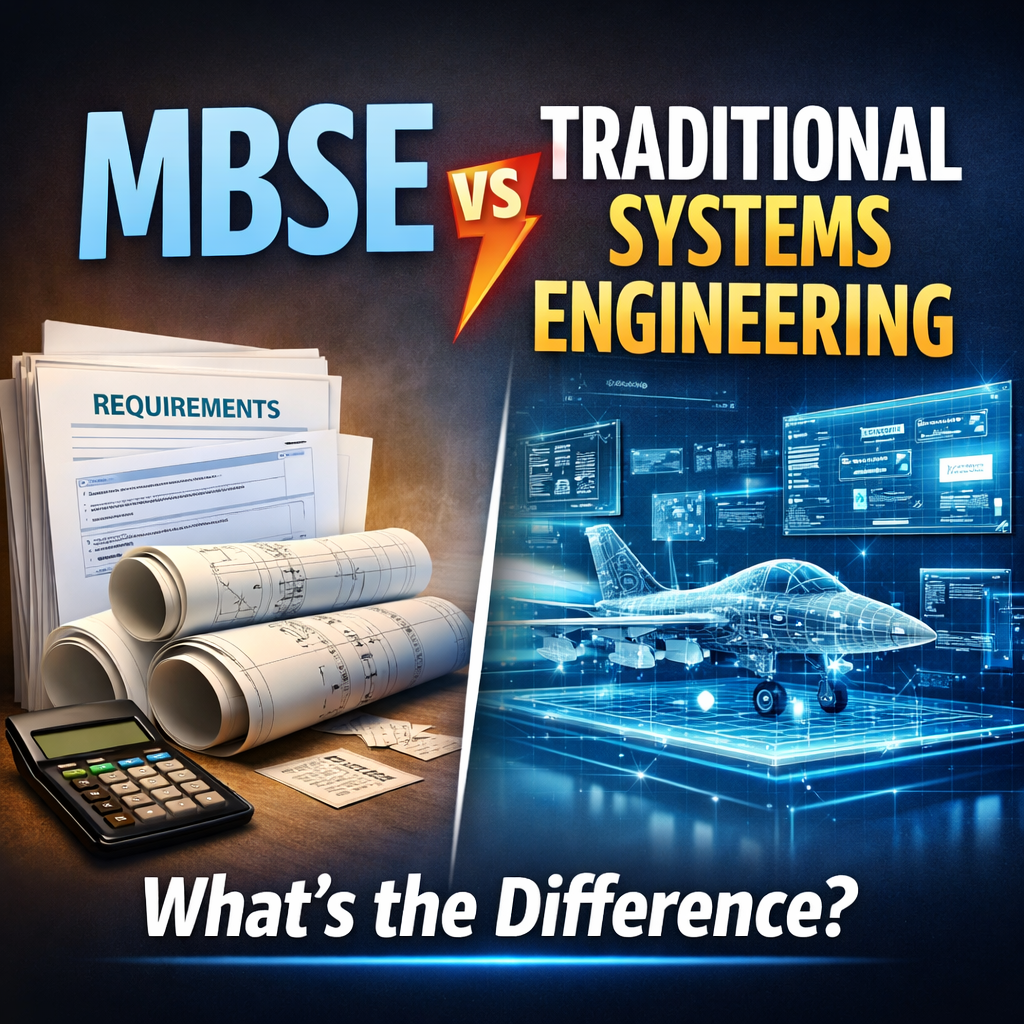
MBSE vs Traditional Systems Engineering: What’s the Difference?
As systems become more complex, organizations are moving away from traditional document-based engineering toward Model-Based Systems Engineering (MBSE).
But what exactly is the difference between MBSE and traditional systems engineering — and why does it matter?
What Is Traditional Systems Engineering?
Traditional systems engineering is a document-centric approach where system information is captured across a collection of documents.
These documents may include:
- requirements specifications
- interface control documents (ICDs)
- design descriptions
- test plans and reports
Each document is typically created and maintained separately, often using tools like:
- Microsoft Word
- Excel
- PowerPoint
Challenges with Traditional Systems Engineering
While this approach has been used for decades, it introduces several key challenges:
- Fragmented Information
System data is spread across multiple documents, making it difficult to maintain consistency.
- Poor Traceability
Tracking relationships between requirements, design, and verification is often manual and error-prone.
- High Maintenance Effort
A single change may require updates across dozens of documents.
- Limited Reuse
System knowledge is not easily reusable across programs.
- Communication Gaps
Different stakeholders interpret documents differently, leading to misunderstandings.
What Is Model-Based Systems Engineering (MBSE)?
Model-Based Systems Engineering (MBSE) replaces documents with a centralized system model.
Instead of writing system information in separate documents, engineers build a connected digital model that captures:
- requirements
- system structure
- behavior
- interfaces
This model becomes the authoritative source of truth for the system.
Key Advantages of MBSE
All system data lives in one connected model.
- Built-In Traceability
Relationships between elements (requirements, components, tests) are explicitly modeled.
- Faster Updates
Change once → update everywhere.
- Improved Collaboration
Stakeholders view the same model through different diagrams.
- Reusability
Models can be reused across future programs and product lines.
MBSE vs Traditional Systems Engineering (Side-by-Side)
Feature | Traditional Systems Engineering | MBSE |
Data Storage | Documents | Centralized model |
Traceability | Manual | Automated |
Change Management | Time-consuming | Instant updates |
Communication | Text-based | Visual models |
Reusability | Low | High |
Consistency | Hard to maintain | Built-in |
Why Organizations Are Transitioning to MBSE
Organizations are adopting MBSE to handle:
- increasing system complexity
- cross-disciplinary integration
- faster development cycles
- digital engineering initiatives
MBSE is also a foundational component of:
Real-World Example
Traditional Approach
A requirement changes → engineers manually update:
- requirements document
- design document
- interface document
- test plan
This can take days and introduces risk of inconsistency.
MBSE Approach
A requirement changes → update one model element → all linked views update automatically.
When Should You Use MBSE?
MBSE provides the most value when:
- systems are complex
- multiple teams are involved
- long lifecycle support is required
- integration across domains is critical
Key Takeaway
Traditional systems engineering relies on documents, while MBSE relies on connected models.
MBSE enables:
- faster decision-making
- improved consistency
- better communication
- scalable system design
For most modern engineering programs, MBSE is not just an improvement — it is becoming a necessity.